Chime: a small model for keyboard prediction
Chime predicts the next word and completes the word being typed in LocalType, my Android keyboard. It is a 2.22 MB model trained from scratch on licensed public text. It runs on the phone; the browser demo runs the same weights locally. It is not Gemma or Gemini and is not derived from either, and running it needs no Google model or service. Two of its five training sources, the Taskmaster dialogues, are datasets Google published under CC BY 4.0; that is the only connection.
I measured model inference on a Pixel 9a and Pixel 10. A separate keyboard pilot tested suggestions, correction and text delivery; it did not control prior learning well enough to rank prediction accuracy.
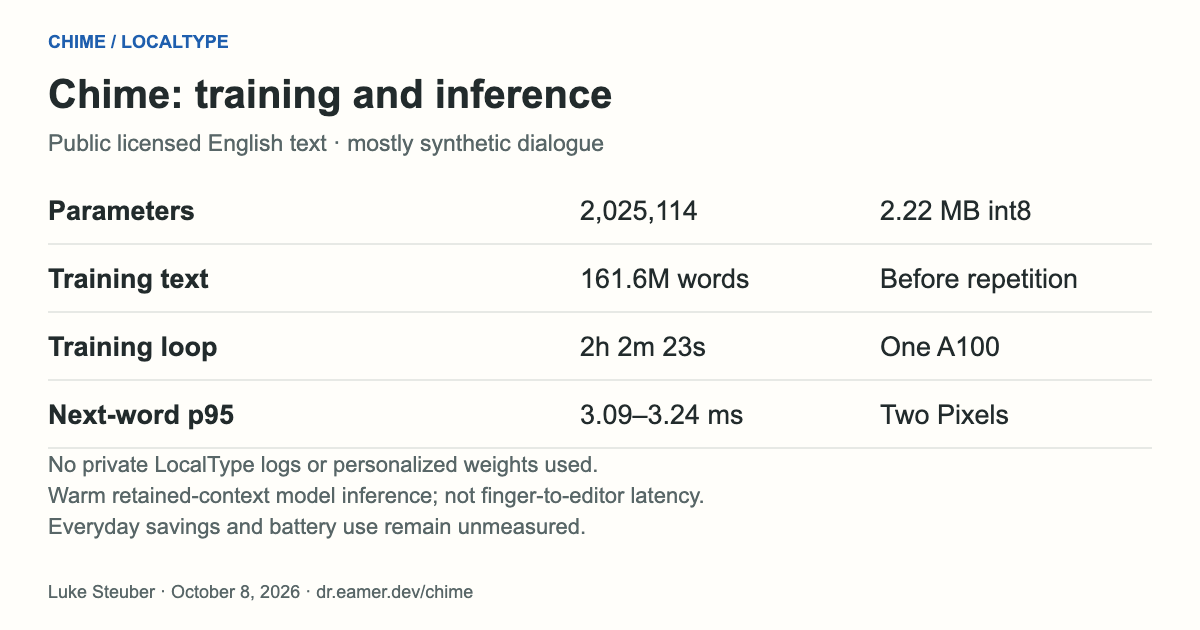
Chime: training and inference
- Model
- 2.03M parameters
- Training text
- 161.6M words
- Training loop
- 2h 2m 23s · one A100
- Warm next-word p95
- 3.09–3.24 ms · two Pixels
Licensed public English text, mostly synthetic SODA dialogue plus human-written SMS, dialogues and prompts. Word count is before repetition; no private LocalType logs were used. Timings measure retained-context model inference, not typing latency.
Comparison with Gboard
On October 11, 2026 I ran an editor-only benchmark: 100 invented sentences, each with two planted typos and two clean words, typed by scripted touches into the same test editor with LocalType 0.5.14 and with Gboard 18.4 beta, on a Pixel 9a and a Pixel 10, after each keyboard’s own reset, scored only from the text that landed in the editor. With taps scattered 14 px around each key, LocalType corrected 134 of 200 planted typos and Gboard 103; at 23.5 px it was 127 against 106, with no clean word changed; at 33 px it was 110 against 100, a difference the interval does not separate from zero. Latency was within a millisecond at the median on one phone and 3 ms in Gboard’s favour on the other. Both phones gave LocalType identical text.
An earlier version of this section quoted taps at exact key centers, 133 against 2. I have withdrawn that figure: Gboard changes behaviour when every tap lands on the exact center of its key, so those rows did not measure it. A separate probe read both suggestion strips on 150 human-written phrases and found prediction at parity: the target was offered before typing for 16 targets on LocalType and 15 on Gboard, and potential keystroke savings were 48.7% against 46.3%. Scripted taps are not human typing, and no speed advantage over Gboard has been measured. The benchmark page has the method, every cell with its interval, the limits and the corrections.
Chime is English-only and has a fixed vocabulary. Its training text includes older Singapore SMS and mostly synthetic dialogue. Everyday prediction savings, battery use and physical typing latency remain unmeasured. Methods and full measurements describe the data, evaluation and numerical checks.